See National Register of Historic Places info. below
An Idea For Its Time
What is a "Civic League" and who ever heard of the Walden's Ridge Civic League? Isn't it the Mountain Opry? What will happen to the building now that the Mt. Opry has dissolved? Who owns it? Is it at risk of being torn down? Who is in charge anyway?
Officially Civic Leagues in the United States started in the 1890's. The idea was (1) to professionalize local government, and (2) to encourage self-government where local residents identified their own problems and found their own solutions.
Walden's Ridge Civic League evolved from the Fairmount School parent teacher association. It was organized in 1929 and incorporated in 1930 when there was little local government. There were no utilities, no police, no fire control, few good roads, and little social support system. The purpose of a Civic League was to provide these services, and the residents of Walden’s Ridge formed their organization with Committees that handled: (a) Legislation and Conference – to connect with city, county and state governments (b) Finance and Budget – to handle money for local needs (c) Publicity and Membership – to build the League (d) Roads – to build, mark and maintain roads (e) Utilities – to set up a water system, to bring in electricity (f) Transportation – to start a bus line and assure trucking services (g) Fire and Police – to provide volunteers to respond to fires, to keep law & order (h) Educating and Health – to teach domestic, farming, hygiene and financial skills (i) Ways and Means – to sustain the League (j) Entertainment – to provide lawn fetes, carnivals, dances, plays, sports teams, etc. (k) Parks and Playgrounds – to maintain common meeting and recreation areas
These Committees worked conscientiously and produced results. Among them were:
- The Civic League brought clean WATER to the mountain and formed the Walden’s Ridge Utility District = WRUD
- WRCL established the first volunteer FIRE department = WRES
- WRCL assured law & order through POLICING
- WRCL brought ELECTRICITY lines to the area
- WRCL built, marked and maintained the ROADS
- WRCL assured a modern SCHOOL = BACHMAN
Today, of course, the Civic League members do not have to work as hard as they once did. We can appreciate our legacy and enjoy it. The early Civic League members hosted carnivals, plays, dinners, dances, music, games, classes, recitals, hay rides, minstrels, bonfires, bar-b-ques, contests, lectures, family gatherings, weddings, parties and more. We hope to repeat these traditions and add new activities that suit the wishes of the residents of Walden's Ridge today.
The Walden's Ridge Civic League owns 3.46 acres with an auditorium, two other buildings, covered pavilion, playground, playing field and track. It was deeded to us for community use on May 22, 1946. As long as the property is used by the people, it belongs to all of us. Won't you join us and enjoy it as we reestablish its place in our community?

History of the Auditorium
Why the People Built an Auditorium
The first school in Hamilton County, Fairmount Academy, was established on Walden's Ridge in 1858 at the little community of Fairmount near an all-weather spring. Later, the newer Fairmount Grammar School was built by the Hamilton County Department of Education about a mile south of the Academy on Fairmount Pike near the point where Anderson Pike and Key-Hulsey intersected with the Pike. It was "newer" but it had no running water. The children pulled water from a well and used privies.
Fairmount Grammar School was the hub of the community, and most of the students were children of coal miners and farmers. In those days, roads were largely dirt. Entertainment was reading from the Bible before the sun went down and attending services of Sunday. The church and neighbors furnished social welfare. There was no fire or police protection. Electricity was a great rarity. For water, a family dug a well, and of course they also dug a toilet pit. Children attended school when they weren't needed to work at home.
Mr. W. V. Beene was the dedicated principal of Fairmount Grammar School. He and the teachers wanted the best for their students, so they urged parents to join them and help. One of the biggest challenges was keeping students in school. If they could build a place big enough to gather the whole community together, they might get better participation at school.
According to notes written in longhand by an unknown record keeper for the Fairmount School Improvement League on November 5, 1920, "There followed a debate on the subject: Shall we build an Auditorium now, or Shall we wait?" Arguing for the affirmative in the formal debate were Mrs. C. W. Shackleford and Mr. T.M. Kell; for the negative were Mrs. A. W. Freudenberg and Mr. Beene. "The judges decided in favor of the affirmative."
From that decision point on, there was a united effort to build an auditorium at the school. Through the following years, countless ice-cream socials, carnivals, fetes, recitations, readings, spelling bees, contests in arithmetic, picnics, tacky parties, watermelon cuttings, turkey shoots, plays, musicals, and more were held at private homes to raise money. Funds for the building trickled in: $5.65 profit from a pie social, $19.70 from a lawn party, $4.80 from playground games.
Members agreed to pay dues of 10 cents if they attended a meeting and a fine of 25 cents if they missed. It was hard and slow. Meticulous accounts were kept of the pennies: 1.5 yards of gravel @ $2.40 per yard plus hauling $8.00; 25 bags of cement $29.10 plus hauling $6.25; cost of nails $15.50 plus hauling $1.00. Most of the work was done by local men and women. Labor donations are listed in the days given: 8, 5, 1.5, 2, 6.
Mr. Hollister, Mr. G. Hauer, Mr. Simmonds, Mr. A.W. Freudenberg, Mrs. Rawlings, Mrs. Stevens, and Miss Burk agreed to be Trustees on April 24, 1922. They went into debt to the lumber company. They took out a loan. Everyone worked like beavers, and they constructed their auditorium well enough in 1921 that it is still in use today.

National Register of Historic Places
WRCL Designation 2026-01-26, part 1
The following account contains the complete narratives of the NRHP application.
It excludes some of the repetitive headers and footers and some checkboxes required in the application. Eight illustrations follow in a separate section.
Walden’s Ridge Civic Center is located in the Town of Walden, Hamilton County, Tennessee on a 3.46-acre lot bound by the intersection of Lyness Street (formerly called Hale Street) to the north and Fairmount Pike running to the east and south. The west elevation/rear of the building faces a large grassy field used for recreational sports, as well as a paved walking track. The east elevation/façade of the building faces Fairmount Pike and a gravel parking lot. Wayside Presbyterian Church sits to the east of the Civic Center across Fairmount Pike. The surrounding area is primarily rural-residential.
The nominated property includes seven resources, four of which are Contributing and three are Non-Contributing. Contributing resources include the Walden’s Ridge Civic Center (1921), Women’s Building (1950), Communications Building (1953, formerly Highway Patrol Building), and Boy Scout Cabin Site (1948). Non-Contributing resources include the Track (1993), Pavilion (1993), and Playground (1992). The property retains its integrity.
WALDEN’S RIDGE CIVIC CENTER (1921, 1988) CONTRIBUTING BUILDING
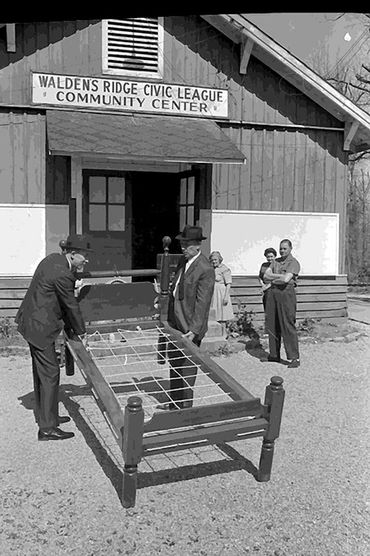
Walden’s Ridge Civic Center is a one-story building with a roughly L-shaped plan. The exterior was originally clad in board and batten wood siding (see Figure 1). Unless otherwise noted, all the exterior walls of the building are clad in coursed wood shake shingles, which were installed in 1967.1
The exterior doors and windows on the entire building were replaced circa 2000. Unless otherwise noted windows are vinyl, six over six, double hung, and all exterior doors are modern replacement doors. The building sits on a stone pier foundation infilled with poured concrete and decorated to imitate a stone foundation.
The east elevation/façade of the building faces Fairmount Pike and features a moderately-pitched front-gable roof with overhanging eaves. The entrance is centered on the façade, filled with six panel double doors, and sheltered by a wood front gable porch supported by two wood poles. The original transom light above the entrance is obscured by a wood board. The porch is accessed by four concrete steps flanked on one side by a simple metal railing. The steps terminate at a poured concrete landing. A seal bearing the words “Tennessee Heritage Trail” adorns the porch roof gable field.2
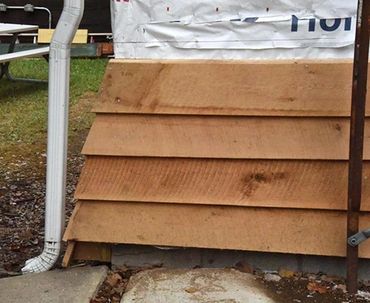
Five brackets are visible on the roofline of the façade, and a large, wood louvered attic vent is located just beneath the gable peak. The elevation previously featured wood shingles. These shingles were removed in 2025 to allow for the installation of wood siding that directly matches the historic appearance of the property (see Figure 1 and 2).3Currently, half of the siding has been replaced with wood board and batten siding. The remainder is covered in Tyvek siding in anticipation of siding replacement. A gravel parking lot extends along Fairmount Pike, in front of the building. This parking lot is the primary access and parking point for the nominated property. (Photo 1)
The north elevation features a total of nine windows. A six panel door with sidelights and transom is located on this elevation. Three concrete steps with a single metal rail access the door. There is one access point to the basement on this elevation, a small wood door used as a coal chute, located to the west of the storm door. A gravel driveway off adjacent Lyness Street leads to another gravel parking area to the northwest of the building. (Photo 2)
The west elevation of the building features a hipped roof line. There are five windows, the southernmost two of which are paired. A new, plywood door accesses the basement on the foundation of this elevation. An interior stone chimney sits near the northwest corner of the elevation and is easily visible from the west and south elevation. (Photo 3)
There are two primary components visible on the south elevation. The original L-shaped building, and a circa 1988 concession addition. The hipped-roof portion of the original building, on the westernmost side of the elevation, features two windows and a foundation level entrance filled with a wood door. Three additional windows are visible on the easternmost portion of the original building. Like the façade, a section on the easternmost side of the elevation is in the process of having wood board and batten siding installed to match the original siding of the building. Situated in the L is the 1988 addition. It is capped by a shed roof covered in asphalt shingles. An extension of the roof shelters a six-panel door. The door is accessed by a wood ramp that leads to a small wood landing in front of the entrance. (Photos 4)
Interior
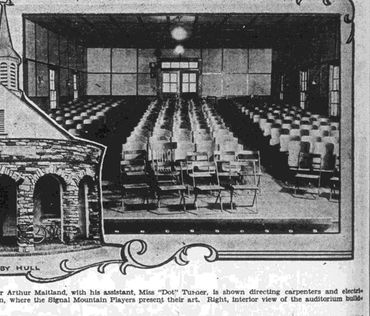
The interior of the auditorium is largely intact with the original wood floors, interior doors, two interior stone chimneys, and historical stage and seating arrangement. The vast majority of interior doors are two panel original wood doors. A set of three steps on the northeast side and another set of three steps on the southeast side provide access to the stage area. There are doors at the top of these stairs to close off the wings of the stage. They are designed to blend into the walls when closed. Dark-stained bead-board wainscoting is present throughout the building (including auditorium seating area, stage, and former classroom - cafeteria rooms). Above the dark bead-board are three quarter inch sheetrock walls painted white with decorative trim details over the seams to resemble shadow box molding. The same shadow box molding continues onto the ceiling and walls throughout the original building, prominently shown in at least one newspaper article (see Figure 2). The 1988 concession addition does not feature any wainscoting or shadow box molding. (Photos 18 and 19)
Three interior doors are located on the southwest side of the stage. The northernmost of these doors leads to the former cafeteria kitchen space, now a storage space. Inside this room are two additional doors on the south wall, each of which accesses a small closet. A brick interior chimney is visible in the northwest corner of the room. (Photo 21, 27, 28) The second door leads to a stairway descending to the basement and emergency exit. (Photo 23) The third leads to the former boys’ bathroom now used as a storage closet.
(Photo 21, 26) A small hallway is also located on the southwest side of the stage, with three other interior doors. One leads to a former green room and prop room for the theatre (now used as the band warmup room.) One is for the former girls’ bathroom now used as a storage closet. The other is to a storage closet.
The warmup room door is particularly interesting as there are two doors, one directly above the other, extending the passthrough to approximately fourteen feet in height. This feature allows for quick changes of tall stage sets between acts. The warmup room also features the only access point to the attic. (Photos 23-25) The original wood accordion doors are still present on the stage, meant to provide privacy when the building was used for both classroom and cafeteria space. The original wood counter and the sliding window used by the children to return trays to the kitchen from the cafeteria are also still intact. (Photos 19-21)
The auditorium seating is not original to the building, but the approximately 200 folding theater seats are replacements purchased from a theatre that closed in Chattanooga in the 1950s. 4 (Photo 18)
The 1988 concession addition has vinyl flooring throughout the hallway, kitchen space, and two separate bathrooms, all accessed by wood doors. Drop acoustical ceiling tile is visible in all spaces. There is a large sliding concession window separating the kitchen from the hallway. The two bathrooms are opposite the kitchen. A six-panel metal exit door is located at the end of the hallway. If entering the concession addition from the main auditorium, there is a metal sign hanging below a fire exit sign that reads, “The Mountain Opry Annex.” (Photos 29-33)
WOMEN’S BUILDING (CIRCA 1950) CONTRIBUTING BUILDING
The Women’s Building (also known as the White Building or Home Extension Building) was constructed circa 1950 and was originally used by the Women’s Home Demonstration Group. It was transferred back to the Walden’s Ridge Civic League in the 1950s. It was later used by a small Episcopalian denomination from 2015 until 2020, when the church disbanded due to low membership.5 It is a rectangular building covered in horizontal wood siding, capped by a front gable asphalt shingled roof, and set upon a concrete block foundation. A wood steeple with paneled sides is visible on the roofline. It was added in 2015 when the Episcopalian denomination occupied the building. Unless otherwise noted, all windows are wood, double hung, and feature wood pediments and sills.
The east elevation serves as the façade of the building. A full length, hipped roof wood porch supported by four wood posts and set upon a stone porch runs the length of the façade. The porch shelters an entrance filled with wood single light two-paneled double doors. The entrance is flanked on either side by simulated stained glass windows surrounded by wood trim and wood shutters. The simulated stained glass was applied in 2015. (Photos 5-6)
The north and south elevation each have three, six over six-light windows and one, eight over eight-light window, all with wood shutters. (Photo 6 & 8) The only architectural feature on the west elevation is a crawlspace entrance in the concrete block foundation. (Photo 7) The main entrance opens into the foyer. A doorway with wood surround is immediately visible on the opposite wall. The floor is original wood, and the ceiling is also wood. The walls are drywall, with the exception of the north wall, which is covered in faux wood paneling. Walls were added on the northeast side of the room to create a bathroom space. It is accessed by a replacement wood, fifteen-light wood door. In the bathroom, the majority of the floor is covered in the original hardwood. The bathroom stall is accessed by a replacement wood door and is covered in laminate flooring. The main room of the building is covered in carpet. The opposite wall is covered in vertical wood paneling. (Photos 34-43)
The Women’s Building is considered a Contributing Building because it is more than fifty-years old, retains integrity, was present during the Period of Significance, and is directly associated with the property’s historical significance. The Women’s Home Demonstration Group was one of many social groups that used the property at the encouragement of the Walden’s Ridge Civic League. After its return to League ownership in the 1950s, it was utilized by both the League and community as a shared space.
COMMUNICATIONS BUILDING (CIRCA 1953) CONTRIBUTING BUILDING
The Communications Building (formerly the State Highway Patrol radio/communications station) was constructed in 1953. It is a rectangular concrete block building capped by a side-gable roof covered in asphalt shingles and set upon a concrete block foundation.6 Exposed wood rafter tails are visible on the north and south elevations. The north elevation serves as the façade. The entrance is filled with a replacement four-panel, two-light door sheltered by a small, front-gable wood awning supported by brackets. It is accessed by two concrete steps. Three window openings are visible on the north elevation. All are filled with plywood, and only the two windows flanking the entrance feature concrete sills. (Photo 9)
An entrance filled with a replacement door is visible on the east elevation. The gable field is filled with horizontal wood board. (Photo 10) Two window openings are visible on the south elevation. Both are filled with plywood and feature concrete sills. (Photo 11) Three window openings filled with plywood and set upon concrete sills are visible on the west elevation. Like the east elevation, the gable field is filled with horizontal wood board. (Photo 11)
The interior walls are unfinished painted concrete block, the floors are concrete with various coverings, and the ceiling is constructed of large drywall panels. Two, two- panel wood doors are located on the east wall and access a long room divided by an internal wall. A metal three-light painted casement window is south of the first entrance. A door immediately west of the main entrance accesses a storage space with built-in wood cabinets. Finally, a door accesses a room on the west wall, which leads to the door on the west elevation. (Photos 44-51) The building was reroofed in 2025 with asphalt shingles following storm damage from a nearby tree.
The Communications building is considered a Contributing Building because it is more than fifty-years old, retains integrity, was present during the Period of Significance, and is directly associated with the property’s historical significance. The communications building was constructed for use by the Tennessee Highway Patrol because of the nominated property’s central location in the community. The WRCL encouraged this construction because it aligned with their mission of providing civic and other kinds of support to the surrounding community.
BOY SCOUT CABIN SITE (CIRCA 1948, 1962) CONTRIBUTING SITE
The original Boy Scout Cabin was constructed circa 1948. It burned down in 1962 and was not reconstructed. The current site is a ruin. Remaining features including the stone foundation, two concrete steps, and a small remnant of the original stone chimney. The Boy Scout Cabin Site is considered a Contributing Site because it is more than fifty-years old and was present during the Period of Significance. It provides additional evidence of the property’s historic role in the community. (Photos 12-13)
TRACK (CIRCA 1993) NON-CONTRIBUTING SITE
The Track was constructed circa 1993. It is roughly rectangular. The pathway is gravel. Within the track is a field covered in grass that is used for sports like soccer and other activities. The Track is Non-Contributing because it is less than fifty-years old and was not present during the Period of Significance. (Photo 14)
PAVILION (CIRCA 1993) NON-CONTRIBUTING STRUCTURE
The Pavilion is a rectangular, open-air structure constructed circa 1993. It is capped by a gable roof with asphalt shingle, supported by eight steel posts, and set upon a poured concrete foundation. The Pavilion is6 Non-Contributing because it is less than fifty-years old and was not present during the Period of Significance. (Photo 15)
PLAYGROUND (CIRCA 1992) NON-CONTRIBUTING SITE
The Playground was constructed circa 1992. It is roughly rectangular in size and features modern playground equipment, including a metal swing set and metal slide. The Playground is Non-Contributing because it is less than fifty-years old and was not present during the Period of Significance. (Photo 16)
INTEGRITY
The Walden’s Ridge Civic League retains integrity and is thus eligible for listing in the National Register. The building has not been moved since its construction in 1921, thus it retains its integrity of location. The construction of residential and religious resources around the building have altered the setting present during the property’s Period of Significance. However, they do not prevent the property from communicating its historical importance as a significant community resource. As such, it retains integrity of setting.
There have been multiple changes to the auditorium building since it was constructed. This includes the installation of wood shingles in 1967, exterior door and window replacement in the 2000s, 1988 addition, auditorium replacement seats in the 1950s, and limited siding replacement in 2025. However, many of these changes are themselves historic and occurred during the Period of Significance, including the wood shingles and the installation of new auditorium seats. Limited siding replacement is based on historical photographs of the building. Further, though the door and window replacements have negatively affected the property’s integrity, the building still retains its original fenestration pattern, with the exception of the elevation with the 1988 addition. Yet even with the addition, the property retains its overall historic L-shape appearance.
Finally, the retention of important features that defined the property historically and facilitated its use as a locally significant resource remain throughout. These include the original wood floors and stage, stage accordion doors, auditorium walls, seat/stage arrangement, interior doors, and wainscoting. Further the retention of the clearly defined audience area, stage, and support/secondary rooms further strengthens the integrity of the building. As such, the property retains integrity of materials, design, and workmanship. Finally, the retention of the above characteristics allows the property to communicate its history as a center for the social life of Walden’s Ridge. As such, it retains integrity of feeling and association.
Statement of Significance Summary Paragraph
The Walden’s Ridge Civic Center is eligible for listing in the National Register of Historic Places under Criterion A at the local level for its Social History and Community Planning and Development significance.
Constructed in 1921, the nominated property served as the auditorium for the Fairmount Grammar School and an important meeting place for the surrounding community. When the Grammar School closed, the Walden’s Ridge Civic Leage (WRCL) assumed stewardship of the building in 1946. The building and property thus became the headquarters for the WRCL, an important organization that orchestrated locally significant community improvement projects, like the installation of water lines and road improvements. Important community enrichment activities, recreational events, entertainment, and social clubs, like the Boy Scouts and the Women’s Demonstration Group, were hosted in the auditorium. WRLC continues to maintain the building and operate it for the community’s benefit.
The Period of Significance is 1921 to 1975, which corresponds with the year that the building was constructed and the default fifty-year cut off point since the center’s importance is ongoing. The Period of Significance is appropriate because it captures the years that the nominated building has been an important community asset to Walden’s Ridge.
Narrative Statement of Significance
BRIEF COUNTY AND COMMUNITY CONTEXT
The Walden’s Ridge Civic Center is located in Walden’s Ridge, a community outside of Chattanooga on Signal Mountain in Hamilton County, Tennessee. Hamilton County was created by the Tennessee General Assembly on October 25, 1819. It was named after Alexander Hamilton. The land for the county was obtained from the Cherokee in 1817 following the Hiwassee Purchase. Land south of the Tennessee River was not initially included. It was only after the disputed Treaty of 1835 and the subsequent forced removal of Native Americans that white settlers gained access to these southern lands.7
Harrison was initially designated the county seat in 1840. However, it was replaced as the county seat by the growing city of Chattanooga in 1870. Other towns in the area include Red Bank, Soddy-Daisy, Ooltewah, Collegedale, East Ridge, Lookout Mountain, and Signal Mountain.8Even in its early years, Chattanooga was an important regional railroad center, a significance which grew exponentially throughout the nineteenth century. The Western and Atlantic Railroad selected Chattanooga as the northern terminus for its rail lines in 1849. Five years later, the Nashville and Chattanooga railroad line was completed through Chattanooga. Other railroad companies that arrived in the city were the East Tennessee, Virginia and Georgia, and Cincinnati Southern railroads.9
When the Civil War broke out in 1861, Chattanooga’s status as a significant railroad, industrial, and commercial hub made it both an important asset to the Confederacy and a prime target for Union forces. Following a defeat at Chickamauga in September of 1863, Union forces fell back to Chattanooga. Confederate forces pursued, and a series of battles and skirmishes broke out that ran from November 23rd-25th, 1863. The result was a decisive Union victory that secured Chattanooga for the United States and laid the groundwork for Major General William T. Sherman’s Atlanta Campaign (NR Listed – 10/15/1966).10
The conclusion of the Civil War signaled the beginning of Reconstruction for cities like Chattanooga across the South. Initial recovery efforts were significantly hampered by epidemics and natural disasters, including a cholera outbreak in 1873, a yellow fever plague in 1878, and damaging floods in 1867 and 1886. Despite these challenges, Chattanooga developed into an important southern manufacturing center, prompting both an industrial and real estate boom in the 1880s. This continued to be an important trend throughout the nineteenth and twentieth centuries. The first Coca Cola bottling franchise was located in Chattanooga, and other important businesses such as Combustion Engineering, DuPont, McKee Baking, Krystal, Moon Pie, Double Cola, and Little Debbie originated in Chattanooga and Hamilton County.11
Much like Chattanooga, the land that now contains Walden’s Ridge belonged to the Creeks and Cherokee before the arrival of white settlers. Walden’s Ridge is a mountainous formation that marks the eastern edge of the Cumberland Plateau. The full ridge extends from Cumberland and Roane Counties to just north of the conjunction of the state lines for Tennessee, Georgia, and Alabama. Available evidence suggests that Native Americans used the ridge as a hunting ground and maintained their villages and any grown crops in the valley. Both the Creeks and Cherokee were forcibly removed from Walden’s Ridge by 1838.12
There are several competing theories on how Walden’s Ridge got its name, with no real consensus.13 What is known is that, initially, Walden’s Ridge was sparsely populated by white settlers. Though many people owned land in Walden’s Ridge, either through land grants or land speculation, there is very little evidence to show that it was occupied by said persons during the early nineteenth century.14 It was not until after the Civil War that a large number of white settlers arrived in Walden’s Ridge and established permanent residences.15
As the number of permanent settlers rose from 1850 onwards, the reputation of Walden’s Ridge as a place of scenic beauty also increased. It was described in 1876 as a destination for those “wishing to escape the heat and dust of the city for a few days,” and many city folk believed Walden’s Ridge was healthier overall than living in Chattanooga.16George W. Ochs summed up this sentiment best in his 1897 publication on the benefits and attractions in Chattanooga and Hamilton County: To the left we have the Anderson Pike, leaving the Washington road at Mountain Creek. The Anderson Pike ascends Walden’s Ridge by easy grades, amid scenery of ever-increasing grandeur until, surmounting the cliffs at the summit, one beholds the broad Tennessee Valley below him with its tracery of stream and road and checker work of cultivated fields. Should the beholder possess a practical mind he cannot help remarking the wisdom and liberality of a policy which has thus rendered accessible the many acres of mountain land to the seeker of healthy homes as well as to the far-seeing investor of capital.17
Ochs’ description of Walden’s Ridge itself touches on an important part of the area’s history and development: the accessibility of the Ridge by a network of reliable roads. As mentioned earlier, Walden’s Ridge is a mountainous formation with steep inclines. Traversing the Ridge on foot was challenging enough. Navigating the landscape with wagons and horses was much more difficult. Roads were generally packed earth. Early travelers could expect it to take hours to go from the bottom of the ridge to the top in a wagon. If it rained, the same roads turned into quagmires that proved almost impossible to navigate.18 These accessibility challenges presented major problems to both the residential and economic growth of the Ridge. Until the problem of roads (and, later, basic infrastructure like water and sewage) was solved, occupants of the Ridge would be at a disadvantage compared to other communities near Chattanooga.
The first attempt at a navigable, reliable road was Anderson Pike, mentioned in Ochs’ 1897 account. The Tennessee Legislature authorized the construction of the pike in January 1840 for the express purpose of promoting growth and travel across the mountain to Chattanooga. Prosperous farmer and congressman Josiah McNair Anderson spearheaded the construction of the road, which was completed sometime in the 1850s.19 It functioned as a toll road until the 1870s and was the most reliable path to the Ridge until the completion of the later “W” Road in 1892 (NR Listed 3/19/1999). According to Patten, the construction of Anderson Pike “did more to open up Walden’s Ridge than any other factor in these early years.”20
Several communities sprang up on the Ridge with the arrival of settlers and improved road system. This included Fairmount, Summertown, Lone Oak, and Sawyers, with Signal Mountain located nearby. Fairmount, the home of Walden’s Ridge Civic League, had humble beginnings. Early family names in the area include Vandergriff, Alexander, and Edmund. The community grew up around Fairmount Academy, one of the earliest subscription schools established in Hamilton County. At the time of its founding, it was the only public building and served as a place of worship and community events. Students could learn reading, writing, and arithmetic at the school. Eventually, a post office, store, and church called Fairmount home. A hotel was also constructed as a way station for travelers along Anderson Pike heading from Sequatchie County to Chattanooga. Fairmount Academy closed when Fairmount Grammar School was constructed in 1911. The Grammar School itself was later replaced by Bachman Elementary (NR Listed 04/17/2001) in 1938.21
WALDEN’S RIDGE CIVIC LEAGUE SIGNIFICANCE
The idea of a civic league or civic club is steeped in tradition. Such organizations have played significant roles in the social, economic, and cultural life of the United States. Authors David Davenport and Hanna Skandera argue that civic organizations were a source of “social capital” that could be spent facilitating the cooperation and coordination of various community members and resources towards the betterment of the whole. 22 As early as the 1800s, groups of different professions and occupations in America formed leagues and clubs to benefit their communities. Alexis de Toqueville famously noted this civic spirit in Democracy in America (1835), writing that Americans were prone to forming groups to “solve both large and small problems” in their community. Civic leagues in the United States began with the formation of the National Municipal League in 1894. This organization sought to professionalize local government and to encourage self-government informed by the unique challenges and assets within a particular locale’s context.23
An example of a civic league is the Walden’s Ridge Civic League, the subject of this nomination. Other civic organizations also proliferated throughout the twentieth century.24 Examples of popular civic associations include Benevolent and Protective Order of Elks, Rotary Club, Improved Benevolent Protective Order of Elks of the World, Kiwanis International, and Lion’s Club.25
Both the Walden’s Ridge Civic League (WRCL) organization and the nominated building evolved from the Fairmount Grammar School. After the Grammar School was completed in 1911, parents and teachers affiliated with the school wanted to expand their physical facilities to provide better opportunities for their children and the surrounding community. The Hamilton County Department of Education was not able to provide financial support for any physical improvements, though it did allow the community to construct a building on the same property as the school, provided they could pay for it. W.V. Beene, understanding the community interest in constructing an auditorium for all to use, put the issue to a vote. The citizens of Walden’s Ridge overwhelmingly voted to construct the auditorium.26
Under the direction of a committee comprised of W.V. Beene, George Hauer, A.W. Freudenburg, and P.S. Henderson, community members worked diligently to collect private donations, donated labor, and gifted materials. An article in the Chattanooga Daily Times heralded the unique project as “being the only [building] of its class in the county schools and in being the only one ever put up in the county by the people of the community for general assembly purposes.”27 The building was finally completed in 1921. Upon its completion, the building was immediately put to use as an auditorium, library, and cafeteria for the Fairmount Grammar School. It was also used as a Sunday School space, election polling station, rabies clinic, and meeting location for several groups, including a Boy Scout Troop. The community also arranged regular lectures in the space, beginning with its formal public opening on November 29, 1923. Speakers included the state supervisor of rural schools, Hamilton County farm agents, elected officials, professors, prohibition supporters, and many more.28Another article also described the building as “the new community hall of the Fairmount community auditorium,” an indication that the building had gained prominence within the community outside of its educational use.29
The immediate use and widespread popularity of the building as the educational and social center of community life resulted in a series of rapid improvements to the building. By 1934, the auditorium had been enlarged, a cafeteria and domestic science room added, and the building repainted.30
Whereas the auditorium rose in prominence, the Fairmount Grammar School, located on the same property as the auditorium and separate from it, faced significant challenges. Like many other schools in growing rural areas, the school was overcrowded. By 1933, a year before the auditorium was significantly improved, the Hamilton County Board of Education approved the construction of a new school building that would include eight rooms and a new auditorium at the cost of $35,000. As the project started during the Great Depression, the county received funds from the Public Works Administration to complete the work. Local architect Reuben Harrison Hunt designed the new school, which was completed in 1937. W.V. Beene suggested that the new school be named the Walden’s Ridge School in honor of the Ridge and its community. Ultimately, it was named the Nathan L. Bachman Elementary School to recognize the late U.S. Senator and his championing of public education.
The Fairmount Grammar School was torn down in 1938, but the auditorium, newly painted and renovated, remained standing.31 It would not have to wait long for its next stewards, who had already been active in the community and, indeed, had been instrumental in its initial construction.
One of the major groups responsible for the Fairmount Grammar School and Fairmount Auditorium was the Fairmount Parent Teacher Association. They were highly motivated and dedicated to the success of the school, believing correctly that investing in the school was the same as investing in the community. Following the successful construction of the school in 1911, members of the PTA set their sights on community improvement beyond strictly educational issues. They recognized the importance of the larger National League’s mission and believed Walden’s Ridge could benefit from an organization that advocated for community improvement, on behalf of the community, in the absence of an organized local government. These seeds bore fruit when on October 4, 1926, the Walden’s Ridge Civic League (WRCL) officially organized, though it would not officially be incorporated until the 1930s.32
The WRCL held their meetings and events at the Fairmount Auditorium from their very inception. When the school closed down and the future of the auditorium looked uncertain, the League pushed the Hamilton County Department of Education to deed both the building and the land around it to WRCL. Their efforts paid off when the Department of Education deeded the auditorium and five acres to the WRCL on May 22, 1946. The deed stated that the building was “to be used to promote the general interest and welfare of this territory. And, that if the property was not used for community purposes or because of lack of interest to continue to operate the Civic Leage, the property would revert to the County.”33
The WRCL had secured a headquarters for their own organization and a valuable resource for the local community. Meeting minutes describe the acquisition of the auditorium building and land as the “greatest accomplishment” of the WRCL.34 Though this was certainly a win for the organization and community, the community improvement programs accomplished by the WRCL throughout the twentieth century could certainly rival this acquisition in terms of positive community impact.
At the time of WRCL’s incorporation, Walden’s Ridge had no utilities, police, fire control, and few good roads. In response, the League formed ten committees:
1. Legislation and Conference, responsible for connecting with city, county, and state governments.
2. Publicity and Membership, which encouraged the growth of the League and ensured people knew of its goals.
3. Roads, to encourage the building, marking, and improvement of roads in the area.
4. Utilities, to encourage the construction of a water line system and the electrification of Walden’s Ridge.
5. Transportation, to start a bus line and secure trucking services.
6. Fire and Police, which would respond to fire and keep law and order.
7. Education and Health, to teach domestic, farming, hygiene, and financial skills.
8. Ways and Means, responsible for securing the finances needed for the WRCL to operate.
9. Entertainment, which coordinated community events like lawn fetes, dances, plays, and sports events.
10. Parks and Playgrounds, which would maintain recreational areas in Walden’s Ridge.35
As the committee list demonstrates, the WRCL was involved in a multitude of community improvement initiatives on the Ridge. For example, members of the league were among the vanguard of the better-roads movement in the area. Their efforts were rewarded with success when the new “W” Road was finished in 1927. A letter from then Roads Committee member Lucius A. Brown contacted various citizens of Walden’s Ridge to celebrate the opening of the road at the auditorium.36
With a reliable road up the Ridge, the WRCL then turned to securing a system of improved roads connecting the various communities on the Ridge. In January of 1930, the WRCL contacted State Highway Commissioner R.H. Baker on behalf of Signal Mountain. An engineering crew had been dispatched to survey a road across the mountain that would connect with Sequatchie County. However, that crew had been recalled. In response, the WRCL wrote Baker urging that “you give this matter your personal attention” and send the engineering crew back out to continue surveying the road.37Though it is unclear if this resulted in the engineering crew’s reinstatement, the WRCL continued to lobby both the state and county governments throughout the early twentieth century to both improve and expand the road network on the Ridge.38
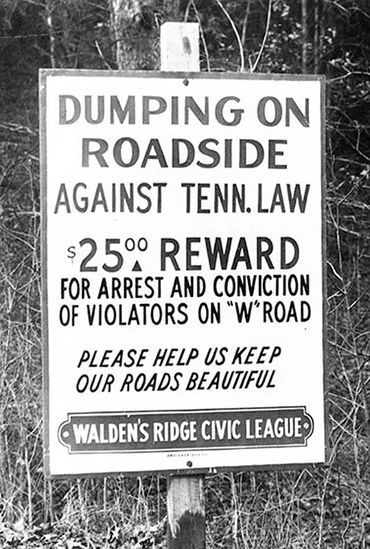
In addition to the roads themselves, the WRCL was also instrumental in the installation of road markers and road shelters. A newspaper article published in The Chattanooga Times described the accomplishments of the WRCL road department, stating that they had recently placed road markers along the highways on the mountain and at the Summertown cross section. These signs helped with traffic and matched existing city of Chattanooga markers to provide continuity for travelers. Further, WRCL initiated the construction of shelters at various points along the highways for bus patrons to use. This included school children and the patrons of bus lines, the latter of which WRCL was instrumental in obtaining as a service for citizens of Walden’s Ridge. Indeed, the Roads Department announced that they had secured the extension of a bus line from Southern Coach Lines to Walden’s Ridge, in addition to other bus lines already secured. Considering that obtaining additional bus lines to the area was a major goal of the WRCL, this announcement documents the ability of the League to accomplish significant community improvement projects.39
Though their road work was important, the WRCL is synonymous with the push to bring water and other utilities to communities on the mountain. The Utilities Committee were discussing ways to solve the water issue on Walden’s Ridge from the time of the league’s formation. Families on the mountain had traditionally relied on wells for their water. However, as growth continued on the mountain, existing wells ran dry as underground aquifers were depleted. This resulted in deeper drilling, a costly expense for families that were, generally, farmers or industrial workers. There was also no guarantee that water found in deep holes could even be used by the families. The deeper one drilled for water, the greater the chance that it would be a “cesspool,” or the water could be contaminated because of the rock formation.40
In response, the WRCL met at Fairmount Auditorium to discuss ways to obtain a water line on the mountain. The Utilities Committee began negotiating with the Soddy-Daisy Falling Water utility company, Hamilton County officials, banks, and private citizens with the hopes that a water line could be installed in the future.41
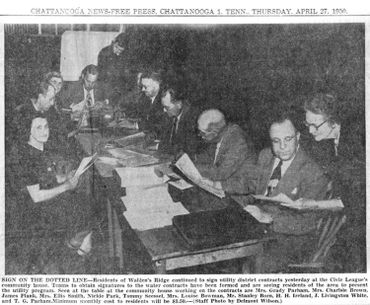
The breakthrough came on April 29, 1950, when citizens of Walden’s Ridge gathered at the auditorium building to learn of WRCL’s plan for obtaining water on the mountain. Sherman Paul, then president of the league, told the gathered people that WRCL had secured a $290,000 Reconstruction Finance Loan (RFC) on the condition that 425 water customers signed up to pay a tapping charge of one hundred dollars each. If this number was not met, the water line project would die. Paul stated that this was the “last chance to get water and every citizen must cooperate.” Also present at the meeting were representatives from bank and loan companies that could provide special rates on loans for water customers.42
Just under a month later, a triumphant article in the Chattanooga News-Free Press announced the “Walden Water Drive” a success. A total of 431 citizens came forward to pay the one hundred dollar tapping charge. President Paul announced a community wide celebration to commemorate the achievement. A motorcade consisting of 125 cars escorted by state highway patrolmen toured the mountain before arriving at the Fairmount Auditorium at 8:00 pm. Once there, guests were treated to a dinner, programs, and various speakers. Awards were also given to volunteers who secured the highest number of commitments to pay the tapping charge.43
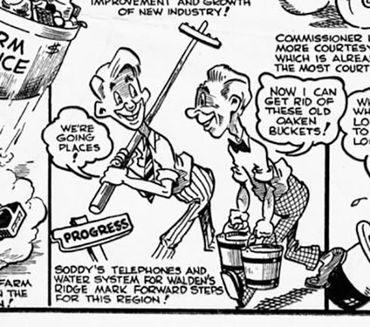
Celebration was not limited to the citizens of Walden’s Ridge. A cartoon on the front page of the June 4, 1950, Chattanooga Sunday Times depicted scenes of improvement and growth in Chattanooga and Hamilton County. One of those scenes featured two men, one carrying a telephone pole and the other two buckets of water (See Figure 6). Both were walking down a path marked “progress.” The caption notes that telephone poles and water from Soddy’s utility system were arriving in Walden’s Ridge. The man with the telephone pole remarked, “We’re going places,” and the man with the buckets replied, “Now I can get rid of these old oaken buckets.”44
The WRCL also hosted many events at the Fairmount Auditorium and encouraged the usage of the property by several locally important social groups. Indeed, this was an important part of the WRCL’s operation.
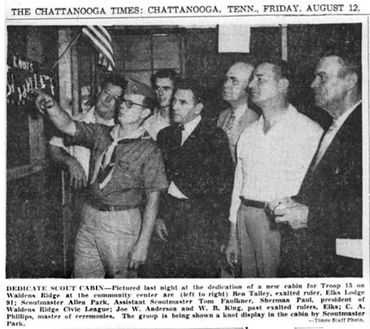
Though most of the money for the league came from membership dues (set at one dollar per year), they also charged some groups a nominal fee for the usage of the building to raise funds for their public projects.45 For additional support, the WRCL held regular dinners, pageants, and other social functions as fundraising events. As popularity and attendance increased, they also began hosting larger festivals and carnivals around 1948, attracting more than 2,000 annual visitors for several years to the property.46 A boy scout troop also used the basement as their regular meeting location from November 1934 to 1940. World War II interrupted scout activities, and they resumed regular meetings at the Civic Center in January 1947 while waiting for a small cabin to be built on the property. A fire subsequently destroyed that cabin on April 19, 1962, and it was never rebuilt.
At least three other groups have historically used the Civic Center for social needs and community development, including The Little Theater, a Woodmen organization, and Wayside Presbyterian Church, who used the building as their place of worship and Sunday School until the current stone church was completed nearby in 1948.47
Because the Civic Center . . .
(See narrative continued in section below.)

National Register of Historic Places - Part 2
WRCL Designation 2026-01-26, part 2
( National Register of Historic Places narrative continued)
. . . Because the Civic Center was originally designed as an auditorium, the necessary infrastructure for plays and other live performances has always been in place. The Walden’s Ridge Civic League often took advantage of that resource, by renting the venue to groups like those listed above, to accommodate their needs while generating a bit of income for ongoing maintenance.
The Walden’s Ridge Little Theatre Association was the first regular entertainment group to utilize the existing auditorium stage and seating, starting in October 1930.48 They often boasted the ability to host plays throughout the summer in the building, due to the temperate nature of the mountain weather. The group also produced one-act plays to serve as fundraising events for things like stage lighting and scenery. These assets and abilities earned the group membership among the Southern League of Little Theaters. In addition to using the space, the theater group also contributed other resources, as per the Civic League minutes: “Mr. Taylor stated that the Little Theatre had installed a new curtain for the stage in the Auditorium and thought the Civic League should assist in caring for the payment of same. Other organizations had made donation in connection. Moved that the Civic League pay $1.50 on the new curtain. Seconded by Andy Hauer and carried.”49 The Little Theatre also requested permission to help build an addition to the Fairmount School Auditorium in 1931, citing a need for the four organizations who primarily used the building to equally contribute.50 This addition and remodeling project was completed by June 1934. By 1947, the Little Theatre disbanded, but a new group called the Walden’s Ridge Civic League Players kept the tradition of live theater going in the auditorium for years afterward.
Another group that utilized the property included a Women’s Home Demonstration Group who helped build the small club house which still stands where the original Fairmount School was located.
The State Highway Patrol even moved their radio and communications center to Signal Mountain in 1953.51The site’s central location persuaded this development, and points to the versatility of the property.52
Today, the Walden’s Ridge Civic League continues to serve the surrounding community by maintaining the Fairmount Auditorium building, now known as the Walden’s Ridge Civic Center. The group holds quarterly meetings in the space and continues to host numerous holiday events and fundraisers for the property.
Although outside the Period of Significance, the building was also used as a live entertainment venue for the Mountain Opry, a group offering live bluegrass and folk music on a weekly basis. The Opry began in 1979 when Fox, a dean at the University of Tennessee at Chattanooga, shared his idea with J.J. Hillis, a retired Signal Mountain barber.53 This weekly concert series was well attended for over forty years, and the Walden’s Ridge Civic Center was central to that success. One resident later described the property as, “an appropriate place for assemblies, entertainments, social gatherings, community projects and, of course, the Mountain Opry.”54 This tradition evolved out of earlier uses of the building. For example, the Lone Oak Mountain Boys provided live music for square dancing at the 1965 New Year’s Eve pie supper Expanding arts and recreation in this rural mountain community continued with the Mountain Opry until 2021 when the group moved their concert series to the nearby Bachman Community Center. Though the Opry may have changed locations, the WRCL remains, meeting in the same building to further their original goal of improving the Walden’s Ridge community.
Figure 1: "Taking a Bed into Walden's Ridge Community Center" (April 18, 1964). Courtesy of the Chattanooga Times Free Press Photograph Collection at the Chattanooga Public Library.
Figure 2: Photograph showing the installed wood on the façade. Photograph courtesy of Karen Stone, August 2025.
Figure 3: This 1933 picture depicts the interior of the auditorium. Chattanooga Daily Times, Chattanooga, Tennessee, November 5, 1933.
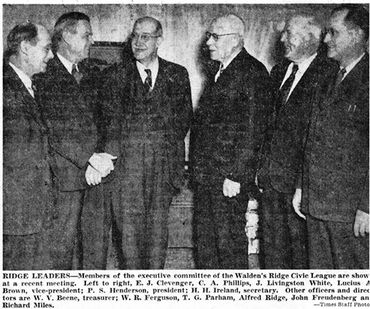
Figure 4: Executive leadership of the Walden's Ridge Civic League at a meeting in the auditorium. Picture courtesy of The Chattanooga Times.
Figure 5: Example of some of the signage installed by Walden's Ridge Civic League. Courtesy of the Walden's Ridge Civic League Collection.
Figure 6: This image depicts residents of Walden's Ridge and members of the WRCL signing utility district contracts in Fairmount Auditorium, described here as the "Civic League's community house." Courtesy of Chattanooga News-Free Press, April 27, 1950.
Figure 7:Cartoon depicting the arrival of utilities on Walden’s Ridge. Courtesy of Chattanooga Sunday Times, June 4, 1950.
Figure 8: Image depicting the dedication of the Boy Scout cabin. Courtesy of The Chattanooga Times

Figures 1 - 8 National Register Document